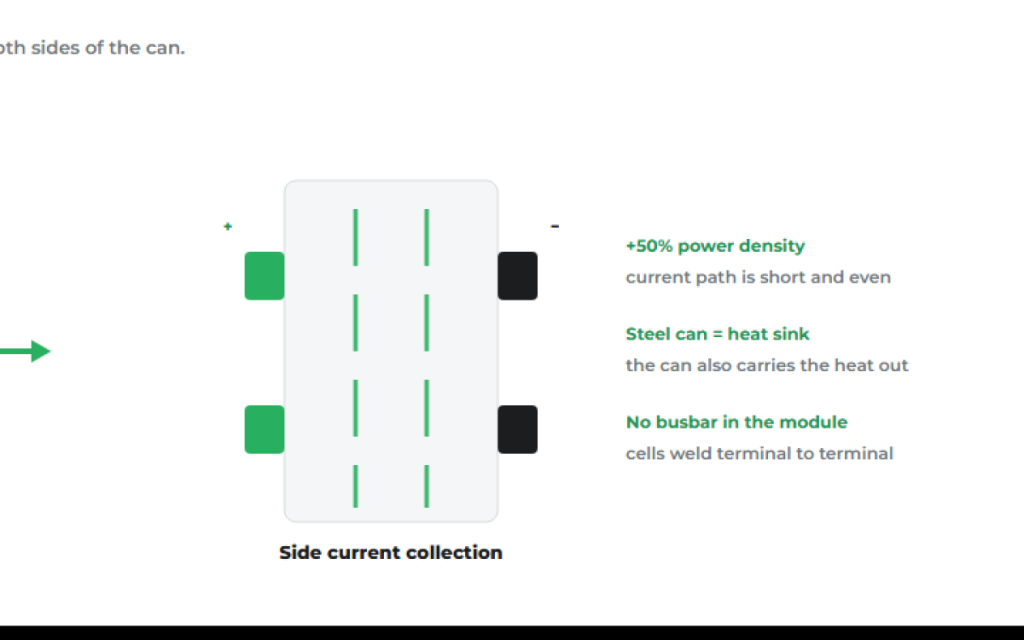
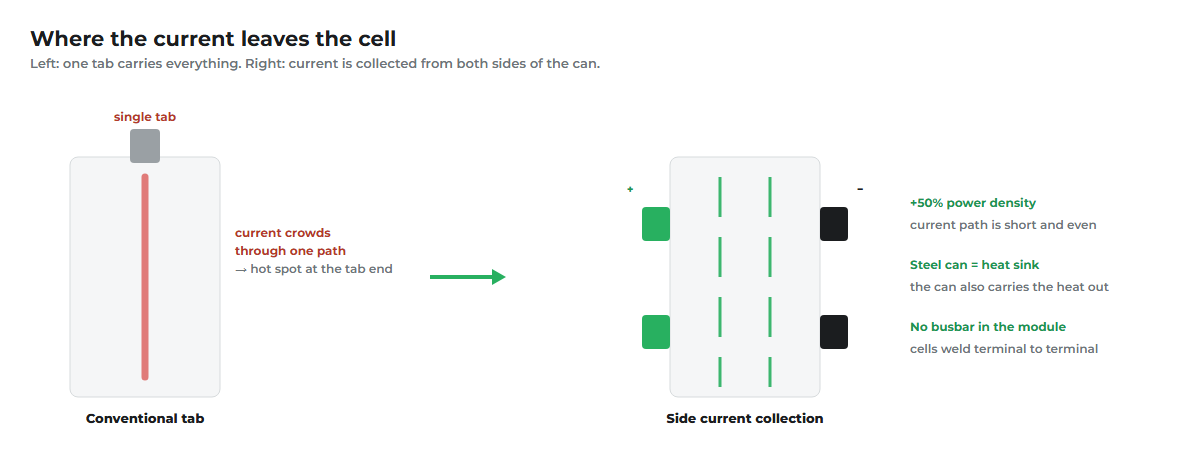
Short answer: a conventional cell takes current out through one tab at the top, so the whole pack current crowds through a single narrow path. Collecting from both sides of a steel can instead shortens that path, cuts contact resistance and raises power density by about 50% — with the same chemistry and the same capacity.
Why is a tab the bottleneck?
Every electrode has to deliver its current to a terminal. In a wound or tabbed cell there is one path for that current, and the end nearest the tab carries the current of the whole plate. That end runs hotter than the rest of the electrode, which limits how hard the cell can be pushed — not the chemistry, and not the capacity.
How does side current collection work?
The positive and negative electrodes are brought out at the two sides of the can instead of the top. The steel can becomes part of the current path, so current enters it along the full height of the electrode rather than at one point. The result is a larger over-current area, a shorter path and a more uniform current density across the plate.
What does it actually change?
| Property | Conventional tab | Side current collection |
|---|---|---|
| Current path | One point per electrode | Full height of the electrode |
| Contact resistance | Higher — concentrated at the tab | Lower — spread over the side face |
| Heat | Hot spot at the tab end | Spread into the can, which acts as a heat sink |
| Power density | Baseline | +50% |
| Consistency | Falls off as the cell gets larger | Holds as the cell gets larger |
How does it scale to bigger cells?
Adding power to a conventional design usually means a thicker tab, which brings its own welding and heat problems. With side collection you add terminals instead: one to N positive terminals on the same can. A 25 Ah cell gets more terminals than a 6.5 Ah cell, rather than a heavier tab.
What does it mean for module assembly?
Cells weld terminal to terminal directly. There is no busbar to add resistance, no separate current collector to buy, and no extra joint to inspect — the module is a stack of welded cells.
How does a cell become a pack?
| Cell | Module | System |
|---|---|---|
| 1.2 V / 6.5 Ah | 7.2 V, 9.6 V or 14.4 V module | 244.8 V or 288 V pack |
| 1.2 V / 25 Ah | 10.8 V module | 604 V system, or 12 V module |
The same cells are already packaged for Toyota and Lexus hybrids — see the 7.2 V and 14.4 V NiMH modules used in those packs.
Frequently asked questions
Does it run cooler?
Yes. The heat path is shorter and the can acts as a heat sink, so the temperature spread across the electrode is smaller at the same discharge rate.
Can modules still be serviced cell by cell?
The cells are welded, so a module is replaced as a unit — which is how hybrid packs are serviced in practice.
Which formats are available?
7.2 V, 9.6 V and 14.4 V modules from 6.5 Ah cells, and 10.8 V / 12 V modules from 25 Ah cells.
Frequently asked questions
What is side current collection?
Bringing the positive and negative electrodes out at the two sides of the steel can instead of through a single top tab, so the can itself becomes part of the current path.
How much more power does it give?
About 50% more power density than a single-tab cell of the same chemistry and capacity, because the current path is shorter and contact resistance is lower.
Does it change the capacity?
No. Capacity is set by the electrode chemistry and mass; side collection changes how the current reaches the terminal, not how much charge the cell holds.