Short answer: a capacitor-type NiMH cell stores charge in a nickel-hydroxide positive electrode and a hydrogen-storage-alloy negative electrode, separated by an aqueous potassium-hydroxide electrolyte. That combination delivers 60–120 Wh/kg, more than 10,000 cycles at 10C, and an operating window of −45 °C to +55 °C — which is why rail and grid projects choose it over lead-acid and nickel-cadmium.
What is a capacitor-type NiMH cell?
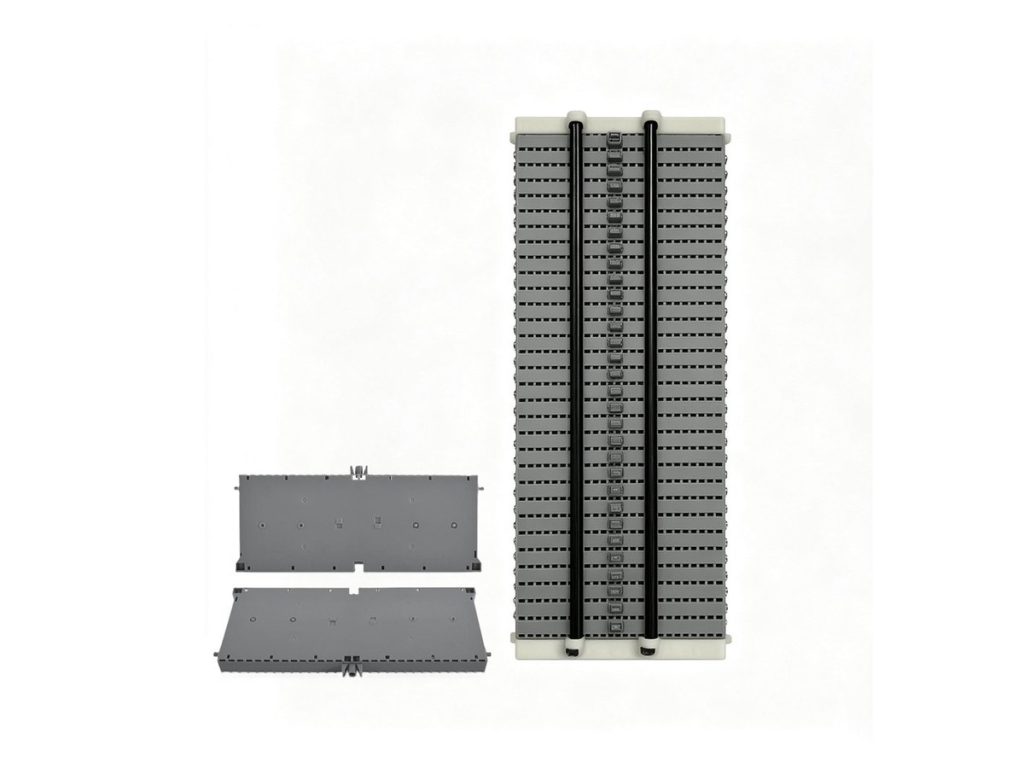
It is a nickel-metal-hydride cell with a stacked (laminated) electrode design instead of a wound jelly-roll. The stack spreads heat evenly across the plate, which is what enables the high-rate behaviour: the cell can discharge at up to 100C without the middle of the electrode running hotter than the edge.
What is inside the cell
| Component | Material | Why it matters |
|---|---|---|
| Positive electrode | Nickel hydroxide, Ni(OH)₂ | High-rate capability, long cycle life |
| Negative electrode | Hydrogen-storage alloy powder | Absorbs hydrogen instead of cadmium |
| Electrolyte | Potassium hydroxide, KOH (aqueous) | Non-flammable; the cell cannot self-ignite |
| Substrate | Nickel foam | High surface area, low internal resistance |
| Additive | Cobalt oxide, CoO | Improves conductivity and plate utilisation |
| Separator | Separator paper | Ion transport, plate isolation |
| Electrolyte support | Solid alkali | Stable electrolyte over the service life |
All main raw materials are domestically sourced with a mature supply chain, so lead time and cost stay predictable across a multi-year programme.
How is the cell built?
- Plate making — positive and negative pastes are mixed, pasted onto nickel foam and cut to plate.
- Separator and stacking — plates are wrapped and stacked, not wound.
- Canning and welding — the stack goes into a steel can, then the cap is welded.
- Electrolyte and valve — KOH filling, then the safety valve is fitted.
- Formation and aging — the cell is formed, rested and aged before testing.
- Capacity sorting — every cell is measured and sorted, so modules are built from matched cells.
- Module and system — cells are welded into 7.2 V, 9.6 V or 14.4 V modules, then into 244.8 V or 288 V packs.
In a vehicle pack those same cells become a 7.2 V, 9.6 V or 14.4 V module, and 20–40 modules become a 144 V–288 V pack. The chemistry does not change between a rail battery and a Prius pack — only the packaging does.
Why does it last 10,000 cycles?
Three things, none of them software:
- Stacked electrode design. Even heat distribution means no local hot spots and no plate cracking.
- Aqueous electrolyte. The cell cannot self-ignite or explode, and there are no toxic materials to degrade.
- Capacity sorting. Modules are built from cells in the same band, so the weakest cell never drags the pack.
The published figure is more than 10,000 cycles at 10C, with a service life beyond 10 years.
How does it compare with lead-acid and nickel-cadmium?
| Capacitor-type NiMH | Lead-acid | Nickel-cadmium | |
|---|---|---|---|
| Energy density | 60–120 Wh/kg | 30–60 Wh/kg | ~50 Wh/kg |
| Cycle life | >10,000 cycles | 300–500 cycles | ~2,000 cycles |
| Safety | No fire, no explosion | No fire, no explosion | No fire, no explosion |
| Operating temperature | −45 to +55 °C | 0 to +50 °C | −45 to +55 °C |
| Environmental | Clean process, recyclable product | Lead — restricted category | Cadmium — phased-out category |
| Charge / discharge rate | 30–100C | <1C | 20–45C |
If you are replacing a pack rather than specifying a new system, the same cell is already packaged for Toyota and Lexus hybrids — see the NiMH packs for Prius, CT200h, Camry and Auris.
What happens under abuse?
| Test | Condition | Result |
|---|---|---|
| Rate discharge | 1C to 100C at 25 °C | Capacity delivered to the end of the curve |
| External short circuit | Dead short across the terminals | No fire, no leakage |
| Overcharge | 1C and 2C to 300% of rated capacity | No fire, no leakage |
| Over-discharge | 1C below 0 V | Recovers after the test |
| Nail penetration | Mechanical penetration | No fire, no leakage |
Full traces from the test bench — rate discharge, short circuit, 300% overcharge and over-discharge — are available in the test report on request.
Frequently asked questions
Is a capacitor-type NiMH cell the same as a normal NiMH cell?
Same chemistry, different construction. The stacked electrode and side current collection are what raise the rate capability; a standard wound NiMH cell is built for energy, not for 100C.
Can it catch fire?
No. The electrolyte is aqueous KOH, and the cell contains no lithium and no flammable solvent. Short circuit, overcharge and nail penetration produce no fire and no leakage.
What temperature does it work at?
−45 °C to +55 °C in service, with a design margin to +60 °C for rail and outdoor grid sites.
Where is it used?
Rail transit batteries, grid primary frequency regulation, hybrid heavy trucks, energy recovery on lifts and port cranes — and, at module level, hybrid replacement packs for Toyota and Lexus.
Frequently asked questions
What is a capacitor-type NiMH cell used for?
Rail, grid storage and high-rate industrial applications where cycle life and rate capability matter more than energy density. It is not a consumer automotive format.
How many cycles does it last?
More than 10,000 cycles at 10C, with an operating window of −45 °C to +55 °C.
Is this the cell used in your hybrid battery packs?
It is the same NiMH chemistry family, but the automotive packs we ship use cylindrical 7.2 V and prismatic 9.6 V modules built for vehicle duty cycles.