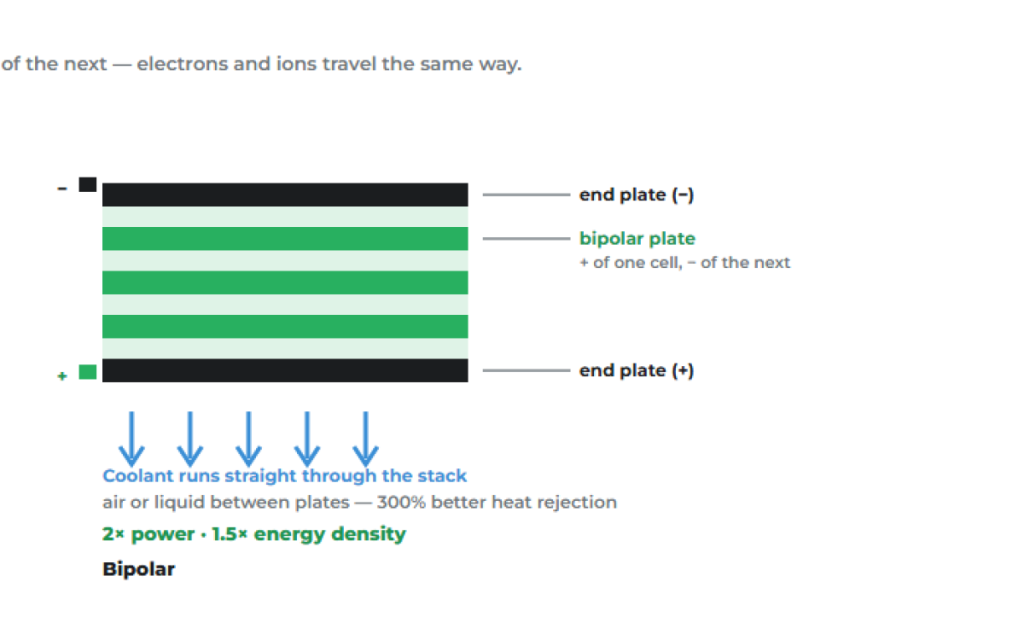
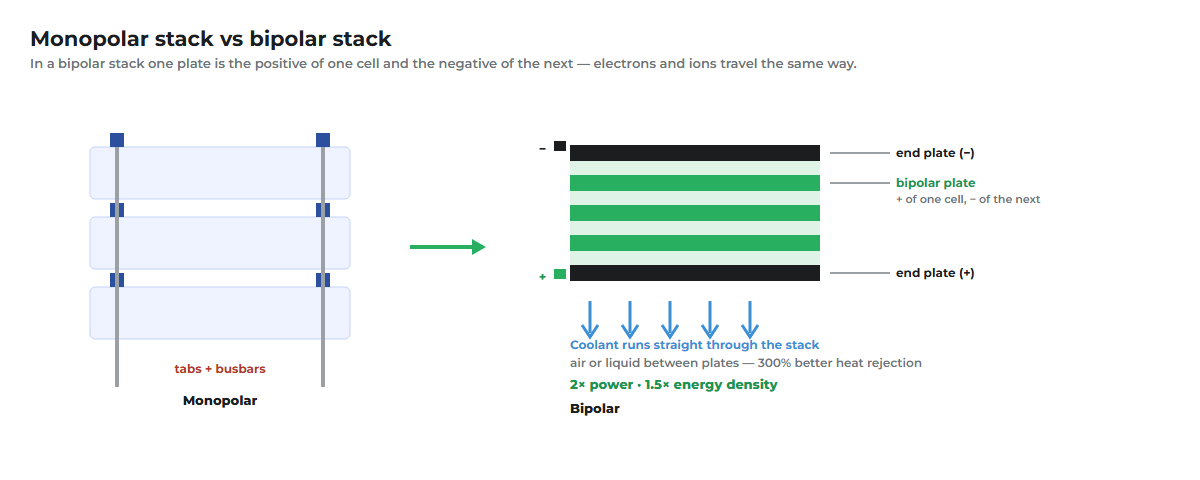
Short answer: a bipolar module stacks cells in series through shared plates instead of tabs and busbars. One plate is the positive of one cell and the negative of the next, so electrons and ions travel the same way. Packaging weight and volume drop, the cooling path becomes direct, and we measure 2× the power and 1.5× the energy density of our monopolar modules, with 300% better heat rejection.
What is the difference between monopolar and bipolar?
In a conventional (monopolar) design every cell has its own positive and negative tab, and those tabs are joined by busbars. In a bipolar stack, the plate between two cells serves both of them: it is the positive electrode of one cell and the negative electrode of the next.
Why does that improve cooling?
The cooling surface sits directly against the plate, so heat does not have to travel through a tab or a busbar to reach it. Coolant — air or liquid — can be routed between plates rather than around the outside of the module. Measured against our monopolar modules, heat rejection is 300% better.
Why is it more consistent?
One plate is one electrode, so cell-to-cell variation is designed out rather than sorted out afterwards. That matters in a rack where a single weak cell would otherwise pull the whole string out of balance.
What does it deliver?
| Metric | Monopolar module | Bipolar module |
|---|---|---|
| Power density | Baseline | 2× |
| Energy density | Baseline | 1.5× |
| Heat rejection | Baseline | +300% |
| Joints per module | Tab welds plus busbars | Plate-to-plate only |
What formats are available?
- 24 V 50 Ah bipolar module
- 96 V 50 Ah bipolar system
- Bipolar plate and cell structure supplied to integrators
Where is it used?
Rail transit battery racks, grid primary frequency regulation and high-power industrial systems, where the module has to survive repeated high-rate cycling in a confined space.
Frequently asked questions
Is a bipolar module serviceable?
It is replaced as a unit. The stack is not designed to be opened in the field, which is how rail and grid operators service these racks anyway.
Does 96 V need a different BMS?
Yes — the BMS is specified per system voltage, and the module-level voltage is fixed by the plate count.
Is this the same chemistry as your packs?
Same capacitor-type NiMH chemistry. The difference is the stack, not the electrode material.
Frequently asked questions
What is the difference between bipolar and monopolar modules?
In a monopolar module every cell has its own tabs joined by busbars. In a bipolar stack the plate between two cells is the positive of one and the negative of the next, so no tabs or busbars are needed.
How much better is a bipolar module?
We measure 2× the power and 1.5× the energy density of our monopolar modules, with 300% better heat rejection.
Can I buy a bipolar module today?
Not as a vehicle replacement pack. The bipolar stack is a platform we are developing; the packs we ship are described in the shop.